Progress with Purpose: Sam's White Water Journey
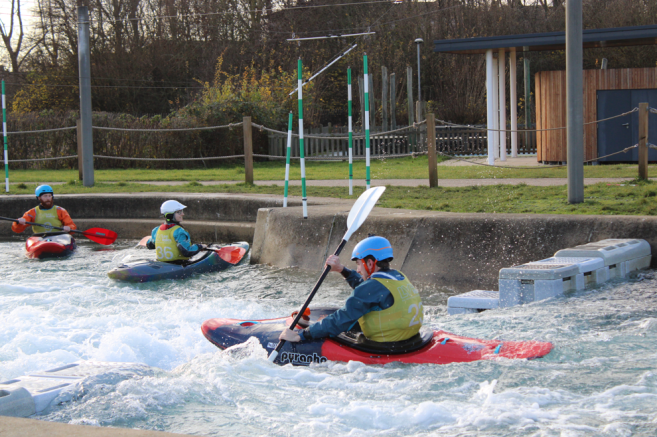
Sam Crowhurst, 24, is a London based paddler currently completing a PhD in biophysics at UCL. His kayaking journey began at the age of eight during a Cubs trip. “I had so much fun that I looked to join a local centre to complete the introductory Paddle UK kayaking awards,” he recalls.
Sam discovered whitewater paddling at university and soon began training at Lee Valley White Water Centre to develop his skills on more technical water. “I had my first taste of whitewater paddling at university and began coming to Lee Valley around the same time,” he says, drawn by the opportunity to progress in a consistent, high quality environment.
Kayaking has become a central part of Sam’s life. “It’s been a fantastic way to stay active, challenge myself and build confidence in my abilities,” he explains. As a visually impaired paddler, Sam has embraced adaptation and resilience to continue progressing. “Working through nerves has helped me become much more resilient over time.”
Progressing from the Legacy Course to the Olympic Course felt like a natural next step. “I’ve always liked having something to work towards,” Sam says, having watched competitions on courses of a similar standard. As his skills grew, Lee Valley White Water Centre, which is turning 15 years old this month, offered what he describes as “the only place where I could take on something this challenging safely.” Regular access to the course played a key role in accelerating his development, highlighting the importance of accessible venues for disabled paddlers.
At first, the Olympic Course appeared intimidating. “I imagined it would be overwhelming,” Sam admits. Once on the water, however, his confidence grew. “With the right guidance and a clear plan for each section, it became something I could approach with confidence rather than fear.” While the stronger flow demanded greater focus, that reassurance encouraged him to return regularly.
Learning the Olympic Course required time and repetition. Unpredictable flow, fast decision making and navigating around other users can be challenging without visual cues. “I’ve had to take time to learn the course.” Studying course maps, identifying large eddies to pause in, and planning multiple routes helped him build a mental picture of the water. Clear communication was also essential, particularly over the sound of the pumps.
Coaching and support have been central to Sam’s progress. “Being guided down whitewater by someone is incredibly helpful because it lets me concentrate on my paddling,” he says. Breaking the course into smaller sections, using clear and simple descriptions, and practical adaptations such as brightly coloured kit all supported his learning. Trust and patience from coaches, including staff such as Sarah and coach Mark Underwood, helped Sam feel safe and capable on the Olympic Course.
Practical adaptations have made regular training possible. Being able to bring a friend to guide him using a carer ticket removed a significant barrier. “That consistency has helped me improve my fitness and paddling skills while still having the support I need to be safe,” Sam explains.
Taking on the Olympic Course has boosted Sam’s confidence on and off the water. “Having a safe environment to train in has allowed me to rely on my skills more.” Looking ahead, he hopes to achieve assessed Olympic Course paddler status and begin exploring freestyle kayaking. Reflecting on his experience, Sam believes: “London is very lucky to have a facility like Lee Valley White Water Centre.”
For those inspired by Sam’s journey, memberships and expert led kayaking courses at Lee Valley White Water Centre offer the opportunity to build skills, gain confidence and become part of a welcoming paddling community - whether you’re just starting out or ready for your next challenge.